
Civic Bridgers’ Theory of Change
Everyone has a social identity – the part of a person’s sense of self that comes from their membership in social groups (such as nationality, ethnicity, gender, profession, or religion). Social identity carries emotional, moral, and practical significance. In most cases, it is normal and healthy to have a social identity. However, in a deeply divided (polarized) environment, the groups that confer it can become unhealthy sources of further division.
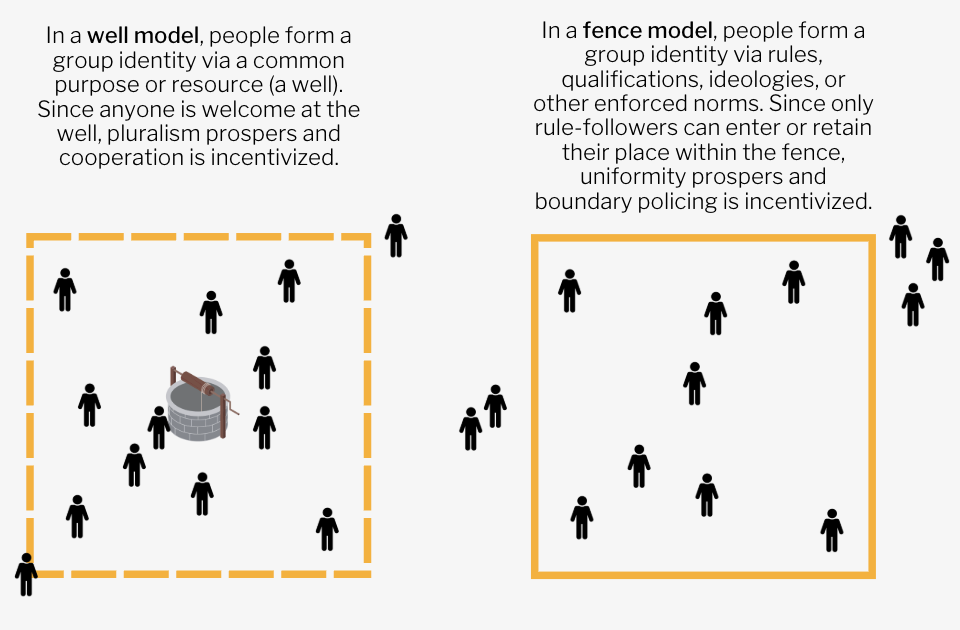
To represent this, we use a Wells and Fences model. Rabbi Jonathan Sacks formally presented the Wells and Fences model in The Dignity of Difference (2002; revised 2003) after studying religious communities. He found that humans naturally sort into groups, but can choose whether those identities create exclusionary boundaries (fences) or shared spaces of encounter (wells).
Within fences, identity is formed by separation, exclusion, and boundary-policing
Around wells, identity is formed by shared depth, encounter, and mutual dependence
American democracy is increasingly divided, with people sorting themselves into smaller and smaller groups defined by fences of ideology and identity. To reduce the polarization and strengthen participatory, citizen-led Democracy, we train leaders to adopt the social identity of Civic Bridgers: leaders who bridge divides through service, encounter, and pursuit of the common good.
The Challenge
American democracy is caught in a vicious cycle. As people withdraw from civic life, public institutions grow weaker and less trustworthy. That erosion, in turn, discourages participation even further. The result is deepening disengagement, rising distrust, and growing polarization.
This cycle is reinforced by what we call a Fence Model, where people define their identity and community through rigid ideologies, values, or group identities. Over time, fences harden into echo chambers, narrowing perspective and intensifying “us versus them” thinking. Fences require separation — they exist to keep others out.
As social psychologist Peter T. Coleman observes, “In demanding situations, we tend to fractionalize more, trusting smaller circles of people, splitting into tinier subgroups, and shrinking our moral scope of people we see as deserving of fair treatment.” In other words, at times when we could most use a well, fences grow taller, tighter, and less humane.
This presents a challenge: In an increasingly polarized nation of fractionalized ideological groups, how can we relate to one another across difference?
Our Approach: A New Social Identity
America needs a new social identity — an identity that creates the conditions for people to move beyond their walls of ideology and toward wells where listening, trust-building, and cooperation take place.
To achieve this, we create Civic Bridgers: leaders who strengthen American democracy through service, encounter, and a pursuit of the common good. Civic Bridgers come from all backgrounds and ideologies – and they don’t abandon their other social identities when they approach the well. Instead, they come to the well with the mindset that multiple viewpoints can coexist and contribute to the common good.
Where fences require separation, wells require cooperation. That’s why democracy thrives around wells and collapses behind fences. Democracy requires Civic Bridgers.
The Evidence
Research in psychology and political science shows that framing voting as part of one’s identity (e.g., “I am a voter”) — rather than as a discrete behavior (“I vote”) — increases the salience of that identity and makes people more likely to register and turn out to vote (Bryan, Walton, & Dweck, 2011). When voting is mentally represented as part of who someone is, people seek consistency with that identity, which boosts participation more than simply thinking about voting as an action to perform. Experiments using subtle linguistic cues to invoke this identity have found higher interest in voting and increased turnout, suggesting that social identity processes help motivate civic behavior by linking self-concept to participation.
We extend this research to the concept of bridging: By framing bridging as part of one’s identity (“I am a Civic Bridger”) rather than a discrete behavior (e.g. “I listen” or “I cooperate”) we believe it will increase the salience of that identity and make people more likely to bridge — to listen, to build trust, to cooperate.
Our Theory in Action
Locally based leaders are uniquely positioned to drive this change. According to social referent theory, people are strongly influenced by information about what others like them are doing, using social norms as a reference point for their own behavior. Research shows that highlighting descriptive norms (e.g., neighbors’ behavior) is often more effective at changing behavior than appeals to personal benefit or moral obligation (Goldstein, Cialdini, & Griskevicius, 2008).
Through intensive training and real-world practice, we develop leaders in the skills and mindsets to be Civic Bridgers. These leaders start by practicing bridge-building in their immediate spheres — their schools, neighborhoods, and local organizations. They learn to facilitate difficult conversations, organize community events that turn out wide-ranging audiences, and build coalitions around shared challenges.
We develop Civic Bridgers who:
Actively participate in public life as champions of pluralism.
Create opportunities for positive contact across group boundaries.
Model three core norms in both civic and private life:
Humanity: Recognizing the equal inherent worth of all people while acknowledging human imperfection.
Humility: Seeking understanding across different ways of knowing and embracing uncertainty.
Accountability: Taking responsibility for how individual actions affect the common good.
As their skills grow, Bridgers create ripple effects by establishing new "wells" of connection — from informal gathering spaces to structured dialogue groups to collaborative community projects. Their example inspires others, gradually shifting cultural norms toward bridge-building. Where they lead, institutions follow: local governments begin incorporating diverse perspectives, organizations reach across traditional boundaries, and communities develop more inclusive decision-making processes.
Civic Bridgers create a revival of pluralism that heals polarization and strengthens democratic institutions.
